Silicone Foam · Material Selection Guide
Thermal Conductive & Conductive Silicone Foam
Nine silicone foam and thermal interface grades compared on thermal conductivity, electrical resistivity, EMI shielding, thickness and hardness — one table, the same numbers we put on the product pages.
Every value below is quoted from the corresponding product page. Cells marked On request are not published on the product page — ask us for the current TDS or for project-specific values.
Swipe the table sideways to see all seven columns → or rotate to landscape
| Product Grade · type | Thermal conductivity W/(m·K) | Resistivity surface / volume | EMI shielding dB | Thickness mm | Hardness Shore | Test basis methods |
|---|---|---|---|---|---|---|
| A · Thermal interface materials | ||||||
|
|
1.2 – 10.0 single range for the grade |
≥10¹¹ Ω·cm volume, @250 V |
— | 0.5 – 5.0 6 standard steps |
Shore 00 35–90 | ASTM D5470 · D374 · D2240 · D792 · D257 · D149 · D412 |
|
|
1.0 – 15.0 | ≥10¹² Ω·cm volume |
— | 0.3 – 5.0 | Shore OO 20–60 | Thermal conductivity tester |
|
|
1 – 15 customizable; standard 3 |
≥10¹² Ω·cm volume |
— | 0.3 – 5.0 | Shore OO 20–60 | On request |
| B · Conductive foams for EMI shielding & grounding | ||||||
|
|
— | ≥10¹⁵ Ω·cm volume, as supplied |
30 – 60 frequency range on request |
0.3 – 15 | On request | On request |
|
|
— | ≤0.1 Ω/sq surface |
70 – 120 100 MHz – 6 GHz |
0.5 – 10 custom |
On request | On request |
| C · Anti-static (ESD) silicone foam | ||||||
|
|
— | 10³ – 10⁹ Ω surface |
On request | 1 – 25 | On request | On request |
|
|
— | 10³ – 10⁶ Ω surface |
On request | 0.5 – 15 | On request | On request |
|
|
— | 10⁶ – 10⁹ Ω surface |
On request | 1 – 10 customizable |
Shore A 50–70 | On request |
|
|
— | 10⁶ – 10⁹ Ω surface |
On request | 0.5 – 10 | On request | On request |
How to read it: thermal grades are specified by thermal conductivity and volume resistivity; conductive grades by surface resistivity and shielding effectiveness; anti-static grades by surface resistivity only. A dash means the property does not apply to that product family.
All three thermal grades keep volume resistivity at or above 10¹¹ Ω·cm, so they work as heat paths while remaining electrical insulators.
Conductive silicone foam reaches 30–60 dB; the die-cut gasket version reaches 70–120 dB across 100 MHz – 6 GHz, with surface resistivity down to ≤0.1 Ω/sq.
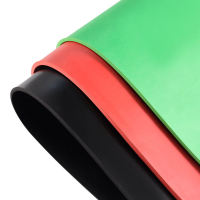
Anti-static grades are available at 10³–10⁶, 10³–10⁹ and 10⁶–10⁹ Ω, from 0.5 mm to 25 mm thickness, in roll, sheet and table-mat form.
The five questions buyers ask most often when comparing these grades.
A thermal pad moves heat across a gap and stays electrically insulating — the three thermal grades in the table all sit at 10¹¹ Ω·cm volume resistivity or above. A conductive foam does the opposite job: it drains charge and blocks interference, with surface resistivity down to ≤0.1 Ω/sq and shielding effectiveness of 30–120 dB.
If a design needs both, use a thermal pad for the heat path and a conductive gasket for the seam.
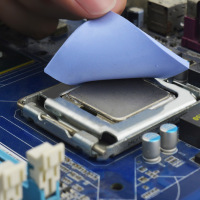
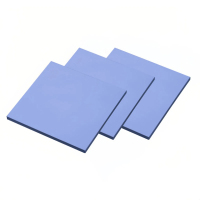
Three families: the SM-T1 thermal pad at 1.2–10.0 W/(m·K), the high-conductivity gap pad at 1.0–15.0 W/(m·K), and the foam-based thermal pad at 1–15 W/(m·K), customizable with 3 W/(m·K) as the standard value.
All three run from 0.3–5.0 mm, the SM-T1 in six standard steps (0.5 / 1 / 1.5 / 2 / 3 / 5 mm). They are supplied as sheets or converted into die-cut pads to your drawing.
Conductive silicone foam is rated at 30–60 dB. The die-cut gasket version, made from nickel- or carbon-filled foam, reaches 70–120 dB across 100 MHz – 6 GHz with surface resistivity ≤0.1 Ω/sq.
The usable shielding level depends on compression, gasket geometry and the frequency band you are protecting, so tell us the enclosure and we will confirm the grade.
Three windows: 10³–10⁶ Ω for fast charge dissipation, 10³–10⁹ Ω as the general-purpose roll grade, and 10⁶–10⁹ Ω for medium-to-high sensitivity electronics — the last one also available as a table mat with Shore A 50–70.
Thickness runs from 0.5 mm to 25 mm depending on the grade. Pick by how sensitive the components are and how fast charge has to leave the surface.
The SM-T1 thermal pad lists a test method per property — ASTM D5470 for thermal conductivity, D374 for thickness, D2240 for hardness, D792 for density, D257 for volume resistivity, D149 for dielectric breakdown and D412 for tensile properties. The other grades are measured on a thermal conductivity tester.
Where the table says On request, the value is not published on the product page. Ask us for the current TDS, a test report, or values measured on your thickness and compression.
Send the gap, the operating temperature, the compression you can apply and the conductivity or shielding target — we will come back with the grade, the thickness and a quotation.