Silicone foam & sponge · cabin interior programmes
Aerospace Cabin Interior Materials
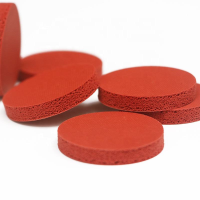
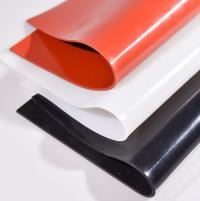
Silicone foam and sponge grades that cabin-interior integrators specify for lining, sealing, cushioning and fire-barrier layers — flame-retardant sheet for the panel stack, low-density sponge where weight decides, and die-cut parts to drawing.
Density drives weight, compression set drives whether a compressed seal recovers, and the UL94 rating is the flame result published for that grade. Every value below is taken from the product page of the grade shown.
Swipe the table sideways → or rotate to landscape.
| Material grade · key dimensions | Density g/cm³ | Flame rating UL94 | Compression set 100 °C |
|---|---|---|---|
|
|
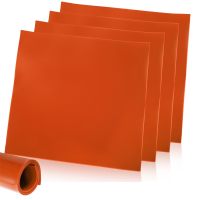
0.47 | V-0 pass |
≤5% |
|
|
0.5 – 1.2 | V-0 | ≤10% |
|
|
0.5 – 1.2 | V-0 option |
≤12% |
|
|
0.85 – 1.0 ASTM D1056 |
V-0 UL file listed |
≤15% |
|
|
0.3 – 1.0 | HB → V-0 option |
≤12% |
|
|
0.5 – 1.2 | V-0 | ≤10% |
Six grades, one row each. The three-column view is deliberate: those are the three properties that decide whether a foam survives a cabin assembly — weight, flame behaviour and how much the seal recovers after compression.
Two cushioning grades carry the lowest densities on the page, and between them they cover what a lining stack usually needs: compressible padding, and a spacer that still holds its shape.
The lightest grade we make. Open-cell architecture lets air pass through the part, Shore A 10 (Shore OO soft) gives the softest touch point, and the sheet runs 1–30 mm thick across -60 to +250 °C.
That combination suits padding behind a trim panel and any spot where the material has to breathe as it compresses.
Potential use — lining spacer, soft pad, acoustic layerThe same weight class with a closed or open cell structure chosen at formulation, uniform cell size through the sheet, and curing between 50–150 °C so it can be moulded into a shaped part rather than only cut from sheet.
Padding, damping and thermal insulation in one material where a gram budget has to hold.
Potential use — cushioning, damping, insulationWhich grade fits comes down to the load, the temperature and the standard your programme is working to. Three cabin-interior scenarios where silicone foam earns its place:
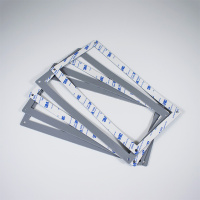
Die-cut gasket stock runs 0.3–1.0 g/cm³ with ≤12% compression set, cut to ±0.08 mm with a 0.3 mm minimum hole — the tolerance range where a seal meets a machined or moulded mating face.
Pressure-sensitive adhesive can be laminated to one or both faces with a release liner, so the part arrives ready to place.
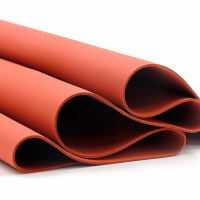
Potential use — trim seal, panel gasketThe ceramized grade is formulated to convert into a ceramic layer when it meets high temperature, and it is published as UL94 V-0 at 0.5–1.2 g/cm³. Fiberglass-reinforced sheet adds structural stability and tensile strength up to 8.0 MPa where a plain foam would sag.
Both are sheet materials that sit inside the panel stack rather than a finished assembly.
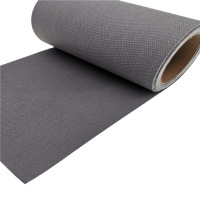
Potential use — thermal / fire barrier layerThe anti-static roll dissipates charge across 10³–10⁹ Ω surface resistivity while cushioning at 0.5–1.2 g/cm³ and ≤10% compression set, and it is published as UL94 V-0.
It is the grade to reach for where a foam pad sits next to avionics, displays or wiring that cannot take a static discharge.
Potential use — ESD-safe pad, electronics cushionThe four things that decide what actually leaves the factory once a grade is chosen.
Die-cutting tolerance, with a 0.3 mm minimum hole size for small apertures and fastener clearances.
Sheet thickness across the range, from thin 0.5 mm V-0 sheet to 30 mm closed-cell block for spacers.
Acrylic or silicone pressure-sensitive adhesive on one or both faces, applied with a release liner.
Red, gray, black and blue as standard, with colour matching, density and Shore hardness set to your callout.
The five questions that come up most often when a cabin-interior team starts specifying this material.
The UL94 V-0 Silicone Foam Sheet (pass at 0.47 g/cm³), the ceramized sheet, the fiberglass-reinforced sheet with V-0 as an option, the closed-cell silicone foam sheet with its UL file listed, and the anti-static roll. The die-cut gasket stock is available from UL94 HB up to V-0.
Each rating is stated on the product page of the grade, with the standard's exact designation.
Density spans 0.13 g/cm³ for open-cell sponge up to 1.0–1.2 g/cm³ for closed-cell and ceramized sheet. The V-0 sheet is the fixed-density option at 0.47 g/cm³.
Thickness runs from 0.5 mm on the V-0 sheet to 30 mm on closed-cell block and open-cell sponge, with ±0.1 mm held on the thinner gauges.
Yes. Die-cutting runs to ±0.08 mm with a 0.3 mm minimum hole size, and foam is supplied from 0.5 mm to 30 mm depending on the grade. Pressure-sensitive adhesive can be laminated to one or both faces with a release liner, and colours are matched to your reference sample.
Send a DXF or PDF drawing with the material callout: we come back with the grade that meets it, the tolerance we can hold on that thickness, and a quotation.
Closed-cell sheet (0.85–1.0 g/cm³, 15–45 Shore A) holds its shape and seals against fluid, splash and dust under low clamping force — the right choice for a spacer or a face seal.
Open-cell sponge (0.13 g/cm³, Shore A 10) compresses further and lets air pass, which suits padding, acoustic layers and any part that has to recover repeatedly. Where the part must cushion and conduct charge away at the same time, the anti-static roll covers it.
The TDS with density, thickness, hardness range, compression set and service temperature; the UL94 report for every grade that carries a rating; and the RoHS, ISO 9001 and ISO 14001 declarations, plus IATF 16949 where the grade is covered by it. Certificates are issued against the order and batch.
Tell us the grade and the application and we send the matching set, so the documents line up with the material you would actually receive.
Send the drawing, the density or hardness target and the standard you are working to — we reply with the matching grade, its TDS and the UL94 report for that grade.