Silicone O-rings are circular seals made from silicone rubber, commonly designated VMQ. Choosing the right one requires both a confirmed ring size and a material suitable for the operating conditions. A ring that fits the groove can still fail if the fluid, temperature, pressure, or movement is unsuitable.
This guide explains silicone O-ring applications, how to measure inner diameter and cross-section, and what to check before ordering. If you already have a drawing or sample, see SENMA’s custom silicone O-rings for available customization options.
Silicone rubber offers flexibility and good resistance to ozone and weathering. Suitable compounds can be considered for equipment housings, covers, and compatible static connections. The industry name alone does not establish that a particular seal is suitable.
| Application | Potential Sealing Location | What to Verify |
|---|---|---|
| Industrial machinery | Housing covers and static component joints | Groove geometry, assembly compression, pressure, and contact medium. |
| Electronics and electrical equipment | Circular cover, port, or enclosure seals | Moisture exposure, temperature, assembly design, and any required ingress testing. |
| Automotive and new energy equipment | Compatible housings and auxiliary component connections | Actual fluid, temperature cycles, vibration, and customer specifications. |
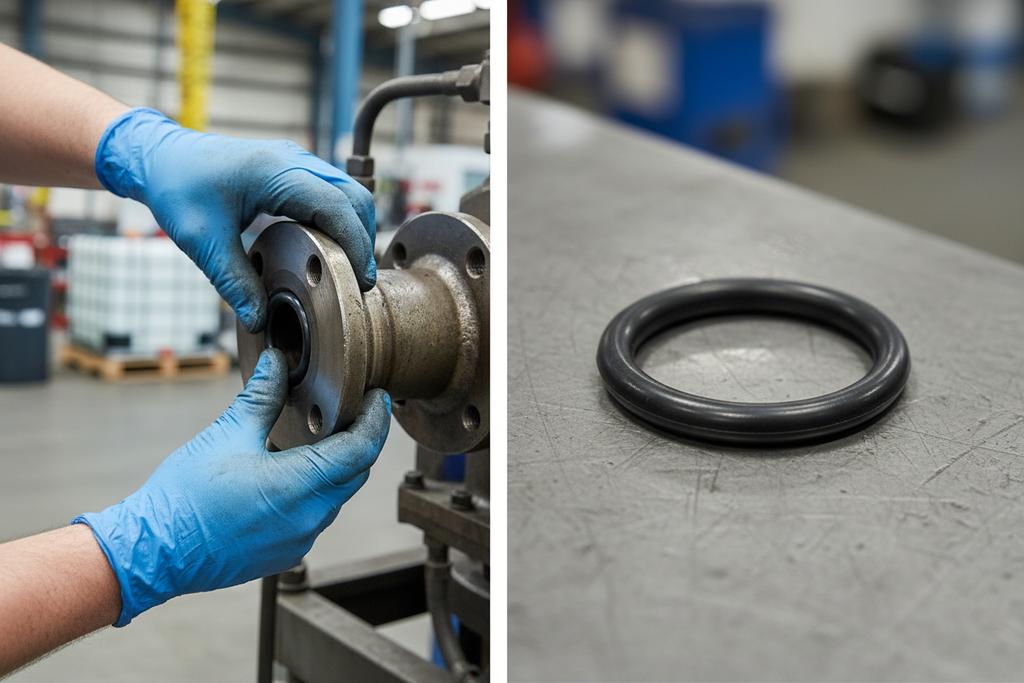
| Pumps, valves, and pipe connections | Selected static flange or fitting seals | Fluid identity, concentration, pressure, temperature, and sealing gap. |
| Semiconductor equipment | Selected equipment connections, subject to specification review | Process chemicals, vacuum conditions, cleanliness, and outgassing requirements. |
For hydraulic, pneumatic, or chemical-processing equipment, identify the exact sealing position and service conditions. A static cover seal and a moving piston seal can require different materials and designs. General-purpose VMQ should not be assumed to meet cleanroom, vacuum, food-contact, or medical requirements without the relevant supporting data.
The most useful dimensions are ID, OD, and CS. Measure the ring in its relaxed state on a flat surface. For small rings or tight tolerances, use suitable measuring equipment and confirm the result against a drawing or size specification.
| Dimension | Meaning | How to Check |
|---|---|---|
| Inner diameter (ID) | Diameter of the opening inside the ring | Measure across the inner opening without stretching the ring. |
| Outer diameter (OD) | Overall diameter across the outside | Measure across the outer edges while the ring lies flat. |
| Cross-section (CS) | Thickness of the rubber cord | Measure the cord gently at several locations without squeezing it. |
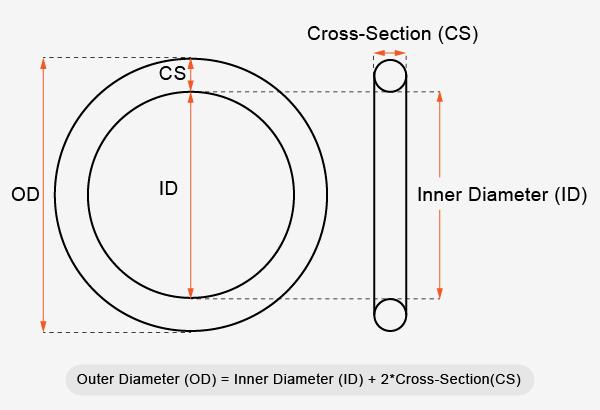
OD = ID + 2 × CS
ID = OD − 2 × CS
CS = (OD − ID) ÷ 2
For example, a ring with an ID of 20 mm and a CS of 3 mm has an OD of 26 mm. Specify it as 20 mm ID × 3 mm CS. This is a dimensional example, not a listed stock size or a groove-design recommendation.
Keep metric and inch dimensions clearly labeled. If you have an AS568 or ISO 3601 size designation, send the complete reference and drawing rather than rounding a measurement to the nearest convenient size.
O-ring dimensions and groove dimensions are related, but they are not interchangeable. The installed seal needs controlled compression, space for deformation, and a design appropriate to the direction of sealing.
There is no single compression percentage that applies to every installation. Use the applicable seal-design guidance for the compound, cross-section, pressure, and static or dynamic arrangement. When replacing a failed seal, check the sealing surfaces and cause of failure as well as the ring dimensions.
Silicone is useful where flexibility and resistance to ozone and weathering are relevant. However, a general silicone material rating is not the same as a specific product specification. SENMA lists −40°C to 150°C for its current custom VMQ silicone O-rings; confirm the selected grade and operating conditions before ordering.
Give the supplier the exact fluid or chemical name, concentration, temperature, and exposure duration. “Oil-resistant” or “chemical-resistant” is not a complete requirement. Standard silicone has limitations with hydrocarbon fuels and several aggressive chemicals; review compatibility for the actual compound and medium.
Silicone elastomers generally have limited tear and wear resistance. Sliding, reciprocating, or rotating contact therefore needs particular care. A ring suitable for a static cover should not automatically be used as a moving shaft or piston seal.
If hardness is specified, provide the Shore A value or the drawing requirement. Color alone does not identify hardness, fluid compatibility, or certification. For food-contact, medical, electrical, flame, cleanliness, or other controlled requirements, state the exact specification and request supporting documentation for the proposed grade.
A clear inquiry helps SENMA review the seal and prepare a quotation against the same requirements you use for purchasing. Include:
You can use this inquiry format: Size: __ mm ID × __ mm CS; tolerance: __; medium: __; temperature: __; pressure: __; static/moving: __; hardness/color: __; quantity: __; drawing or sample: __.
Measure the inner diameter (ID) and cross-section (CS) of a clean, relaxed ring without stretching or squeezing it. Alternatively, measure outer diameter (OD) and CS, then calculate ID = OD - 2 × CS. Check the original drawing or groove if the old ring is worn, swollen, or permanently flattened.
O-rings are commonly specified by inner diameter × cross-section. Outer diameter × cross-section can also be used if it is clearly labeled. Always state the units; if you use a standard size code, include the applicable standard.
A thicker cross-section changes the installed compression and groove fill. It may prevent correct assembly or damage the seal. Check the specified ring size, groove dimensions, sealing surfaces, material, and operating conditions before changing the cross-section.
Suitability depends on the specific compound and service conditions. Standard silicone has limitations with hydrocarbon fuels and wear-intensive motion. For oil, fuel, hydraulic, reciprocating, or rotating service, provide the exact medium and operating details for material and seal-design review.
SENMA lists -40°C to 150°C for its current custom VMQ silicone O-rings. Confirm the selected grade and actual medium, temperature exposure, pressure, and installation conditions before ordering. Do not apply a generic silicone temperature rating to every product.
SENMA offers custom VMQ silicone O-rings based on drawings, samples, or confirmed specifications. Send ID and cross-section, tolerances, application, medium, temperature, pressure, and quantity. Include hardness, color, and documentation requirements when specified.
Start with the required ID and cross-section, then check the groove, medium, temperature, pressure, and movement. If you only have a used ring, share both the sample and the installation details so the replacement can be reviewed against its actual sealing duty.
Need a custom silicone O-ring for your equipment? Contact SENMA with your drawing or sample, dimensions, working conditions, and quantity to request a quotation.
Technical reference: Parker O-Ring Handbook, Section 2.2.13, for general silicone material characteristics and limitations; see the static and dynamic seal sections for design guidance. General handbook data does not replace the specification of the product being ordered.


